

Give Your Affirmations a Job: 5 Ways to Turn Positive Self-Talk Into Progress
An affirmation can be more than a reassuring sentence. These five step-by-step approaches connect identity, curiosity and imagination with practical action—without pretending that thoughts control everything.

Imagine sitting down to begin a project you have postponed for weeks. You could tell yourself, “I am unstoppable.” Or you could say, “I am learning to start before I feel ready. Today, that means writing the first paragraph.” For this hypothetical situation, the second sentence offers something the first does not: a clear assignment.
That is the approach to affirmations explored here: give encouraging language a job. Use it to define a direction, ask a useful question, imagine a worthwhile possibility or prepare a response to difficulty. The aim is not to force yourself into constant positivity. It is to connect the life you want with something you can practice.
What affirmations can—and cannot—establish
One distinction matters before beginning. In psychological research, self-affirmation often means reflecting or writing about personally important values, such as kindness, learning or relationships—not repeatedly declaring that you are successful. A major research review describes how these exercises can reduce defensive responses to threats to a person's sense of worth. Evidence for values-based exercises should not automatically be treated as evidence for every motivational slogan. Read the research review.
Nor is a more extravagant affirmation necessarily a better one. In two experiments published in 2009, participants with low self-esteem who repeated or positively considered the statement “I'm a lovable person” felt worse than comparison participants; benefits for those with high self-esteem were limited. This does not establish that all affirmations backfire, but it does challenge the advice to repeat an unbelievable statement harder. Read the experiments.
For this guide, manifesting means clarifying a desired future and participating in bringing it about. You may also understand the practice spiritually; the exercises leave room for that personal meaning. However, the studies cited here concern psychological processes and goal pursuit, not proof that thoughts directly arrange external events. None of the five formulations below guarantees an outcome, and the exact set has not been tested as a single intervention.
1. “I am…”: Define an identity you can practice
Suggested formula: “I am someone who practices [quality] by [specific behavior].” Instead of claiming a finished transformation, try describing how you intend to show up. Given the evidence that some strongly positive statements can backfire, treat believability as a design constraint—not a lack of ambition. This wording is a practical adaptation, not a formula validated by those experiments. See the study's findings.
- Choose a quality rather than a trophy. Consider reliability, courage, patience or curiosity instead of fame, wealth or universal approval.
- Find an honest starting point. If “I am confident” feels false, try “I am learning to speak even when I feel nervous.”
- Add a visible behavior. For example: “I am becoming a reliable creator by spending ten minutes on my draft after breakfast.”
- Review the practice, not your worth. At day's end, note what you did. If you missed it, choose a smaller next step rather than issuing a verdict on yourself.
Try it: “I am someone who takes my ideas seriously enough to test them.” Then choose one modest test: a rough sketch, a sample paragraph or a question to a potential customer.
2. “Show me…”: Turn aspiration into an investigation
Suggested formula: “Show me one practical opportunity to [goal] that I can investigate today.” Treat this as an instruction for your own search, whether you address it to yourself, life or a spiritual source. The exercise is to look deliberately—not to declare every coincidence a message.
- Name a bounded target. Replace “Show me abundance” with “Show me one opportunity to use my editing skills.”
- Define what would count. Perhaps a suitable vacancy, an organization with an actual need or a person willing to discuss the field.
- Look somewhere concrete. Review a relevant job board, examine a community noticeboard or contact a professional association.
- Check before acting. Ask whether the opportunity is credible, suitable and worth its costs. Include evidence against pursuing it.
Try it: “Show me one realistic way to make this project easier to begin.” Then inspect your tools, schedule and scope. Your answer might be an available template—not an extraordinary sign.
3. “Wouldn't it be great if…”: Imagine the destination, then find the bridge
Suggested formula: “Wouldn't it be great if [meaningful outcome]? What obstacle can I address next?” The second sentence matters. In four experiments, researchers found that induced, idealized positive fantasies produced less energization than comparison conditions. That is not an argument against hope; it is a reason not to confuse enjoying an imagined achievement with preparing to pursue it. Read the fantasy experiments.
- Picture a meaningful improvement. “Wouldn't it be great if I finished the week with a draft I could share?”
- Describe its value. Write one sentence explaining why it matters beyond looking successful.
- Name a present obstacle. For example: “I keep researching because sharing imperfect work feels uncomfortable.” Also acknowledge external constraints rather than treating every barrier as a mindset problem.
- Build a bridge. “I will draft one section without opening another research tab, then mark the gaps for later.”
This pairing of a desired future with a present obstacle resembles mental contrasting. Research on mental contrasting combined with specific action plans supports modest improvements in goal attainment, though results vary. It does not establish that the phrase “Wouldn't it be great if” has a special effect. See the meta-analysis.
4. “Will I…?”: Ask yourself for reasons, not obedience
Suggested formula: “Will I [specific action]? Why would I choose to?” A 2010 study across four experiments found advantages for interrogative self-talk—questions such as “Will I?”—over declarative wording such as “I will,” on anagram performance and exercise intentions. The researchers linked the effect to internally motivated reasons for action. These limited tasks do not establish a universal rule, but they offer a useful alternative to commanding yourself. Read the self-talk study.
- Ask about one action. “Will I spend fifteen minutes preparing my application tonight?”
- Answer with your own reason. “Yes, because this role would let me develop skills I care about.” Avoid answering only with “because I should.”
- Listen to hesitation. If your honest answer is no, ask whether the task is too large, poorly timed or attached to someone else's goal.
- Choose a workable commitment. “I will identify the application requirements tonight and draft the opening tomorrow.”
Try it: “Will I make space for this goal today—and what makes it worth choosing?” Let the answer guide your commitment rather than treating reluctance as a forbidden thought.
5. “If…, then I will…”: Prepare for the moment that usually stops you
Suggested formula: “If [specific cue or obstacle], then I will [manageable response].” Psychologists call this an implementation intention: a plan that connects a recognizable situation with an action. A 2021 meta-analysis of 21 studies found a small-to-moderate average benefit when these plans were combined with mental contrasting. The authors also warned that publication bias might make the actual benefit smaller. Read the meta-analysis. ([pubmed.ncbi.nlm.nih.gov](https://pubmed.ncbi.nlm.nih.gov/34054628/?utm_source=openai))
- Identify a recurring stopping point. “When I finish work, I reach for my phone instead of beginning my personal project.”
- Choose a recognizable cue. Use “after I close my work laptop” rather than “when I feel motivated.”
- Attach a small response. “If I close my work laptop, then I will open my draft and work for five minutes.”
- Add a recovery option. “If an urgent responsibility interrupts me, then I will choose the next available five-minute slot.”
Try it: “If I start telling myself I have already ruined the day, then I will choose one useful action I can still take.” Make restarting part of the plan.
Measure participation, not perfect positivity
For the next week, choose one formulation and one goal. Each morning, write your sentence and identify the action it calls for. Each evening, record what you attempted, what happened and what needs adjusting. Treat this as a personal experiment, not a scientifically established seven-day transformation program.
Keep outcomes separate from judgments about your character. If an application is rejected, examine fit, feedback and alternatives; do not conclude that you failed to believe strongly enough. Leave room in your practice for disappointment, uncertainty, practical support and changes of direction.
The most useful question may not be “Did I say my affirmation correctly?” but “What did this sentence help me do?” Let imagination propose a future, let curiosity investigate it, and let action test the route. You need not pretend the destination is guaranteed to make the next step feel possible.
Sources and references
- The Psychology of Change: Self-Affirmation and Social Psychological Intervention
- Positive Self-Statements: Power for Some, Peril for Others
- Positive fantasies about idealized futures sap energy
- Motivating Goal-Directed Behavior Through Introspective Self-Talk: The Role of the Interrogative Form of Simple Future Tense
- A Meta-Analysis of the Effects of Mental Contrasting With Implementation Intentions on Goal Attainment.
More to read

The Case for the Unfilled Minute: What Productive Daydreaming Really Requires
A spare minute no longer has to remain spare: there is always a feed, a message, or a miniature task waiting …

The Lens That Becomes a Life: How Mental Paradigms Shape What We Notice, Choose and Call “Manifestation”
Our deepest assumptions do not necessarily command the universe, but they can strongly influence perception, …

Your Watch Says You’re Stressed. What, Exactly, Does It Know?
A “high stress” alert can reflect poor sleep, a hard workout, alcohol, illness, a warm bedroom—or psychologic…
Apps to use
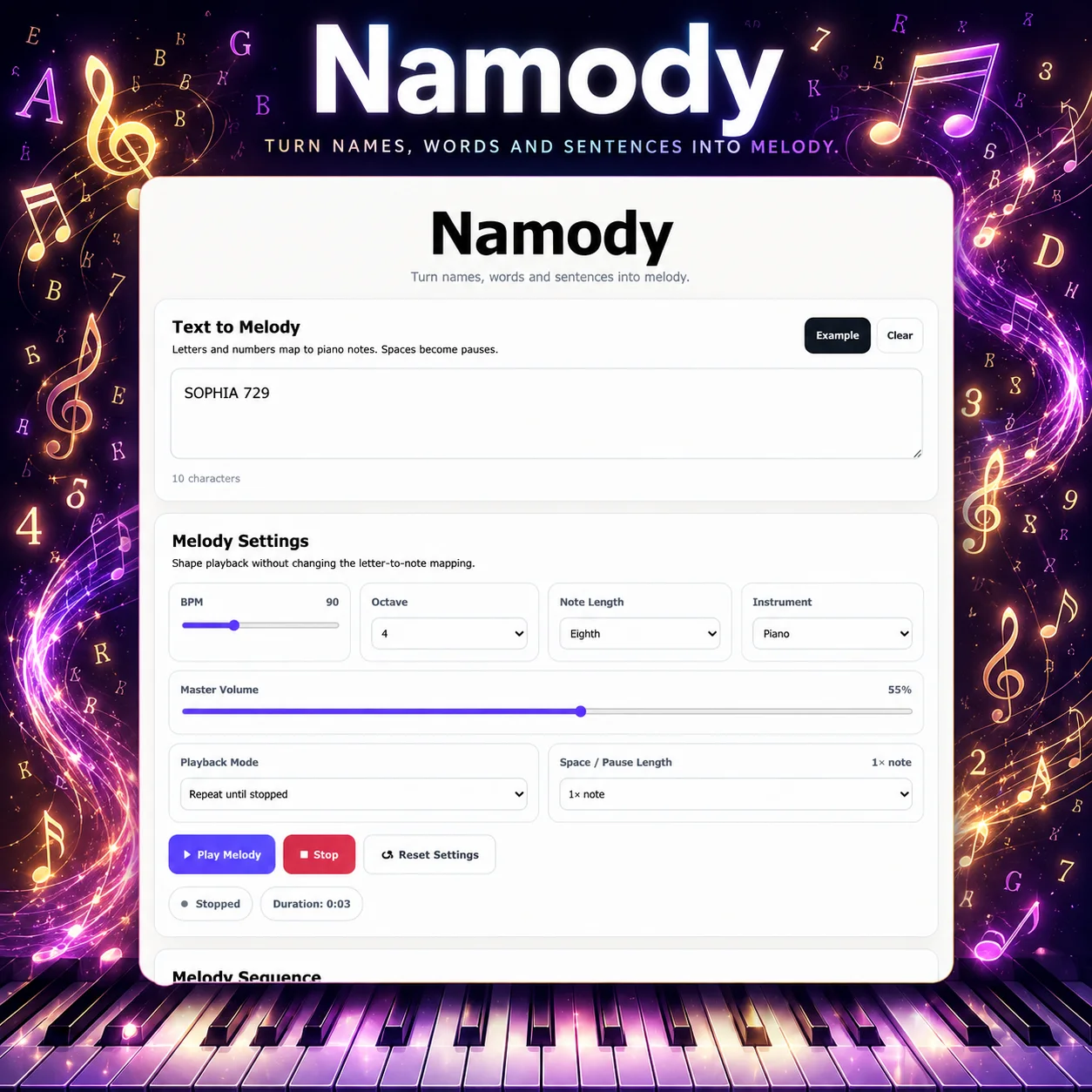
Namody
Turn names, words, numbers, and sentences into unique melodies.

Omina Crystals
Explore 304 crystals and minerals, their characteristics, traditional associations, working methods and symbo…

Sigil Maker
Turn words, intentions and number sequences into unique visual sigils using Gematria and the Numeromudra 0–9 …