

Why Do We Dream? The Science Behind Sleep and Dreams
Dreams are among the most familiar mysteries of human life. Neuroscience has clarified when and how they arise, but the deeper question—why we dream—remains open, with evidence pointing to links with memory, emotion and conscious experience.
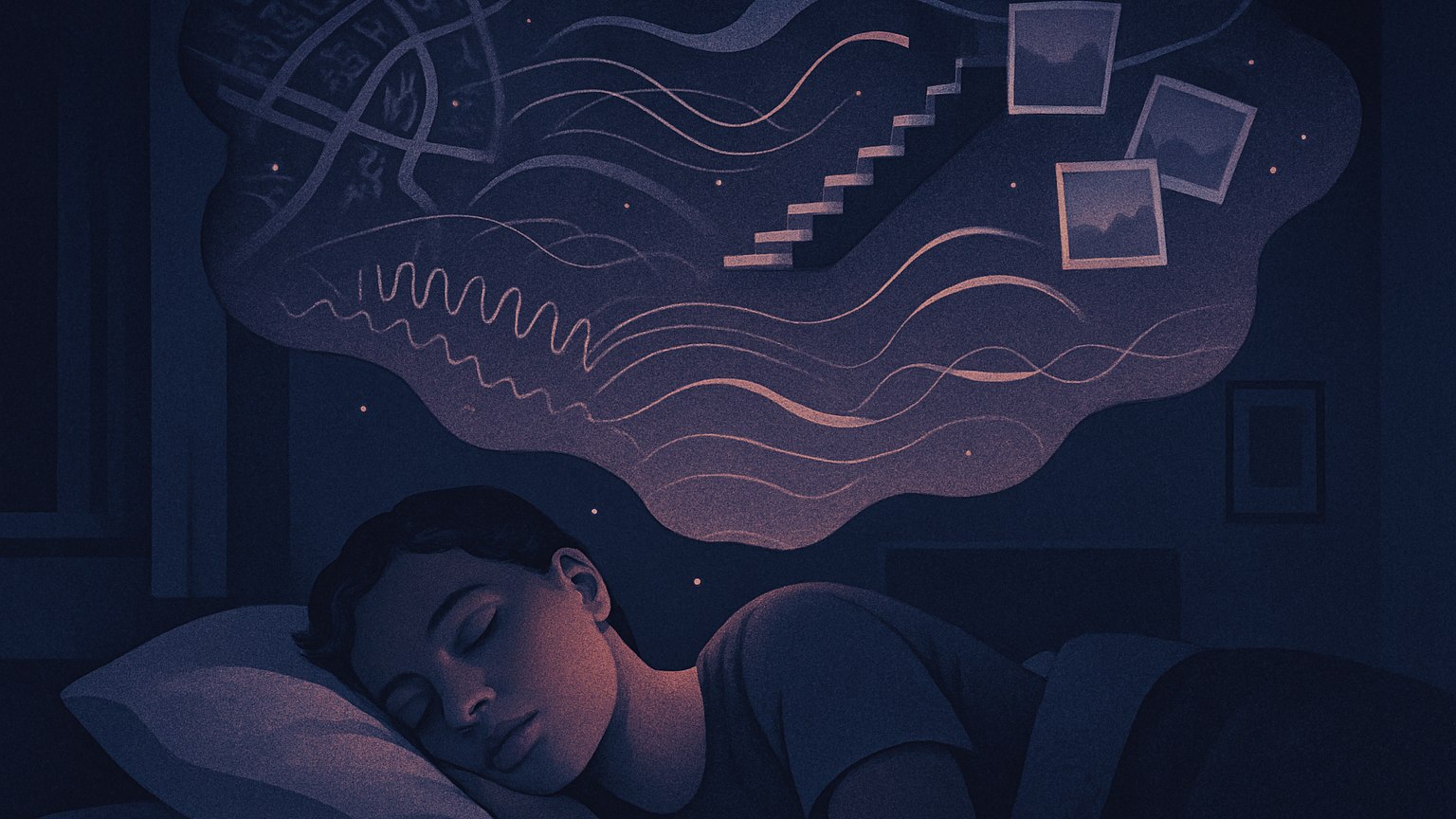
Most people have had the strange experience of waking from a dream that felt immediate and convincing: a conversation with someone long gone, a city that changes shape from one street to the next, or an urgent problem that vanishes with the alarm. Dreams can be vivid, emotional and wildly implausible. Yet they are not simply evidence that the sleeping brain has “switched off.” They are signs of a brain moving through distinct biological states, reactivating and recombining information while disconnected from most of the outside world.
Science has made substantial progress on the mechanics of dreaming. It has not delivered one settled answer to the larger question of why dreams exist. The most defensible conclusion is that dreaming may reflect several processes rather than a single purpose: the sleeping brain’s ongoing construction of conscious experience, its handling of recently acquired memories, and perhaps its broader work of integrating emotion and knowledge.
Sleep is not one uniform state
A typical night alternates between non-rapid-eye-movement sleep, or NREM, and rapid-eye-movement sleep, or REM. NREM includes lighter stages and deep, slow-wave sleep. REM first usually appears roughly 90 minutes after sleep begins and returns in repeated cycles through the night. During REM, brain activity measured at the scalp becomes more wake-like, breathing and heart rate become more variable, the eyes move rapidly beneath closed lids, and most skeletal muscles are temporarily inhibited.
This physiology explains part of REM sleep’s long-standing fascination. The brain can be highly active while the body is largely still. REM awakenings often produce long, vivid and story-like dream reports. But the familiar equation of “REM equals dreaming” is too simple. People also report dreams after NREM sleep, including dreams that can sometimes be detailed and bizarre. On average, REM dreams tend to be more immersive and emotionally intense, while NREM reports are often briefer or more thought-like—but there is meaningful overlap between the two.
That distinction matters because sleep researchers study dreams by waking participants at particular moments and collecting reports. A remembered dream is therefore not a direct recording of every mental event that occurred overnight. It is a report made after awakening, shaped by memory and by whether the sleeper can retrieve the experience at all. Forgetting a dream does not necessarily mean that no dream occurred.
The brain constructs a world from the inside
Dreams feel real in part because they recruit systems involved in perception, movement, place and social experience, even though sensory input from the environment is greatly reduced. In a widely cited high-density EEG study, neuroscientist Francesca Siclari and colleagues found that reports of dreaming in both REM and NREM sleep were associated with reduced low-frequency activity in a region toward the back of the cortex. The researchers called it a posterior cortical “hot zone,” encompassing areas involved in integrating sensory information.
The result did not identify a single “dream center,” nor did it solve the purpose of dreaming. It did offer an important clue: the presence of dream experience is linked to local patterns of brain activation, not merely to the label of a sleep stage. In the same work, patterns of higher-frequency activity also tracked aspects of reported content, such as faces, speech and movement. Dreams are not random pictures projected onto a blank mind; they appear to be internally generated experiences assembled by recognizable neural systems.
Why are they so often illogical? During sleep, the brain is not continuously checking its interpretations against the external world. Memories, expectations and emotions can be combined without the usual demands of reality testing. A familiar person may appear in an unfamiliar place because the dream is not replaying a stored episode frame by frame. It is constructing a new scene from fragments, associations and current brain activity.
Memory is a leading clue—not a final answer
One influential idea is that dreams are related to memory consolidation: the process by which newly learned information is stabilized and reorganized after experience. Sleep itself is strongly linked to memory processing, but it does not follow that every dream is a memory rehearsal or that dreaming is required for every kind of learning.
Still, there is intriguing evidence. Experimental studies regularly find fragments of recent experience in dream reports. A person who has learned a navigation task, spent time in an unfamiliar laboratory or practiced a new association may later dream about elements that resemble those experiences, usually in altered form. In one study of a spatial-navigation task, participants whose NREM dreams contained task-related imagery showed better later improvement on the task than participants whose waking thoughts contained similar material.
A 2023 meta-analysis combined 16 studies that tested whether dreams about a pre-sleep learning task were associated with better memory afterward. Across the included studies, task-related dreaming was linked with improved post-sleep memory performance. The association was statistically reliable for dreams collected from NREM sleep in the subset of studies using sleep recordings, but not for REM reports. That pattern is informative, but it is not proof that the dream itself caused the memory benefit. Dream content may instead be a visible byproduct of underlying memory reactivation.
That caution is central to dream science. A dream about an exam may show that the brain is processing concerns or recent information; it does not establish that the dream was designed to improve test performance. Likewise, a bizarre dream is not necessarily a coded message waiting to be decoded. Modern research generally treats dream narratives as data about sleeping cognition rather than as universal symbols with fixed meanings.
Emotion, creativity and the limits of certainty
Dreams are often emotional, and REM sleep involves strong activity in brain systems relevant to motivation and affect. This has prompted theories that dreaming helps the brain process emotional experiences, simulate possible threats, or integrate feelings with older knowledge. Other proposals suggest that REM sleep supports flexible association-making, which could help explain why dreams readily connect distant ideas.
These hypotheses are plausible, but they remain contested. A recent review of the neuroscience of dreams emphasizes that proposed functions range from memory and emotion processing to threat simulation and “unlearning,” yet no single account has achieved broad confirmation. The important distinction is between a useful hypothesis and an established biological purpose. Researchers can measure sleep stages, brain rhythms, dream reports and next-day performance; demonstrating that a subjective dream narrative has one indispensable evolutionary function is much harder.
There may also be no one-size-fits-all answer. NREM and REM sleep have different physiology, and dream experiences vary across the night. Some dreams may be closely tied to recent events; others may arise from older memories, emotional concerns or spontaneous neural activity. The same dream could reflect more than one process at once.
The enduring mystery
So, why do we dream? The careful answer is that scientists do not yet know in the singular. Dreams occur when the brain remains capable of generating conscious, perceptual experience during sleep. Their content often draws on memory, and research increasingly connects learning-related dreams with later memory performance. Their emotional force may reveal a sleeping brain integrating personally significant material. But none of this makes dreams a nightly instruction manual from the unconscious, and none proves that every dream serves a distinct practical function.
What dreams clearly show is that consciousness is not confined to waking life. As the body rests, the brain cycles through highly organized states and, at times, builds a temporary world from within—one that can be forgotten in seconds, yet still offers scientists a remarkable window into memory, perception and the nature of the mind.
Sources and references
- Understanding Sleep — National Institute of Neurological Disorders and Stroke
- The neural correlates of dreaming — Nature Neuroscience
- A meta-analysis of the relation between dream content and memory consolidation — Sleep
- Dreaming of a learning task is associated with enhanced sleep-dependent memory consolidation — Current Biology
- What are the neural mechanisms and physiological functions of dreams? — Neuroscience Research
- The effect of dream report collection and dream incorporation on memory consolidation during sleep — Journal of Sleep Research
More to read

The Lens That Becomes a Life: How Mental Paradigms Shape What We Notice, Choose and Call “Manifestation”
Our deepest assumptions do not necessarily command the universe, but they can strongly influence perception, …

The Case for the Unfilled Minute: What Productive Daydreaming Really Requires
A spare minute no longer has to remain spare: there is always a feed, a message, or a miniature task waiting …

The List Is Not the Tradition: Why Living Heritage Cannot Be Preserved Like a Monument
UNESCO can recognize a ritual, a craft or a musical tradition—but recognition is not the same as keeping it a…
Apps to use

MIDI Art Studio
Transform images into musical art! MIDI Art Studio converts pictures, logos, and drawings into colorful piano…

Image Toolkit
Edit, resize, crop, enhance, optimize and export images directly in your browser with one powerful all-in-one…

Acupreference
An interactive acupuncture and acupressure reference for exploring points, channels, traditional uses, and pr…