

When Money Stops Sleeping: How Instant Payments Are Rewriting Corporate Cash Management
U.S. instant-payment networks are moving from novelty to serious commercial infrastructure. The bigger shift is not simply faster transfers: it is the disappearance of timing buffers that businesses once used to manage receivables, supplier payments, fraud controls and liquidity.
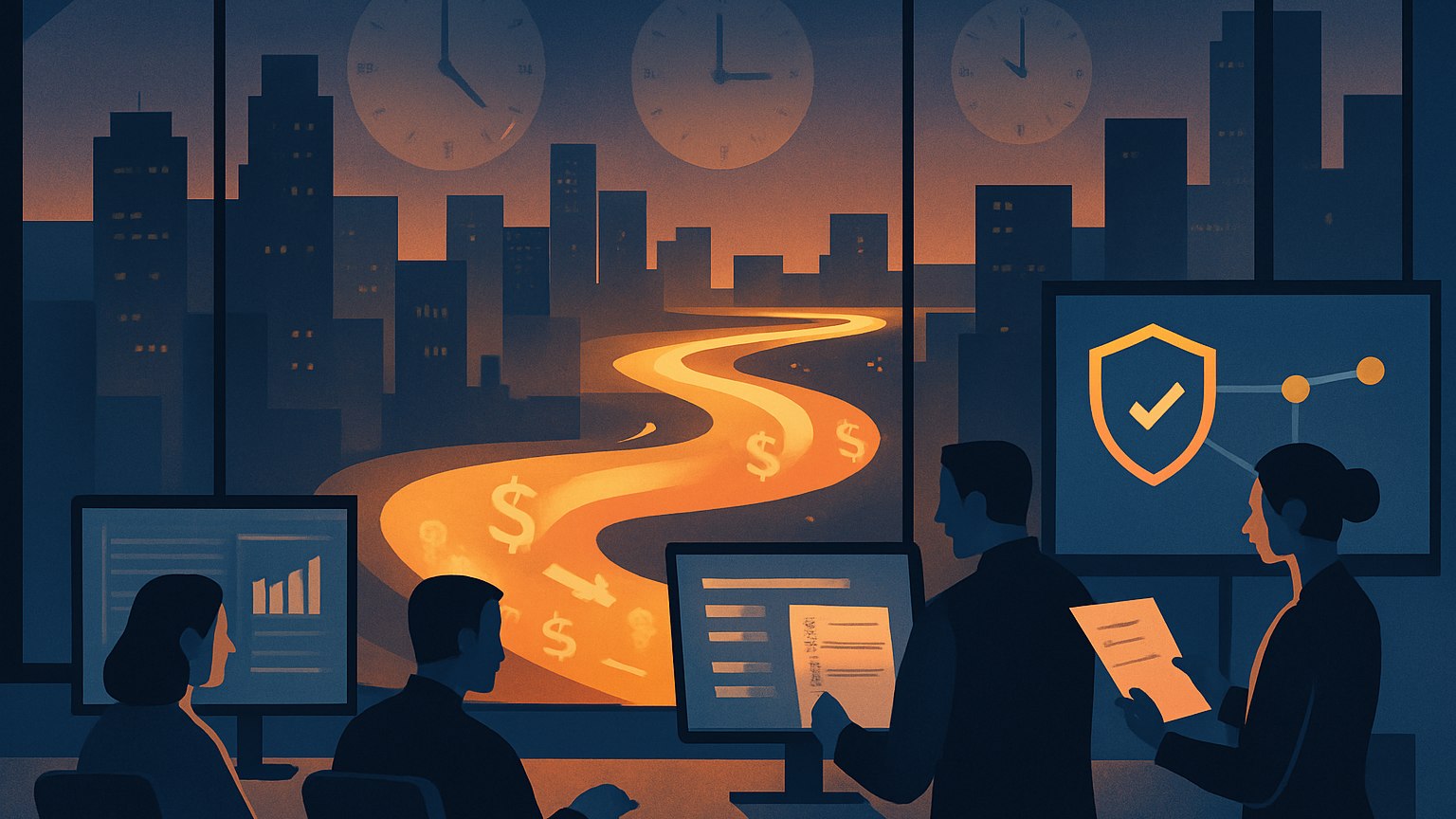
For generations, business cash management was built around delay. A check sat in the mail. An ACH payment settled on a schedule. A wire had a cut-off time. Finance teams learned to live inside those gaps, using them to forecast balances, reconcile invoices and decide which bills could wait until morning.
Instant payments challenge that operating model. In the United States, the Federal Reserve’s FedNow Service and The Clearing House’s RTP network can move funds around the clock, with recipients able to use money immediately. That does not mean every company will suddenly pay every invoice in seconds. It does mean that the old assumption that money movement naturally pauses overnight, on weekends and at month-end is becoming less reliable.
The scale is no longer theoretical. FedNow settled 8.4 million payments worth about $853.4 billion during 2025, according to Federal Reserve Financial Services. The RTP network handled 447.2 million payments worth roughly $1.45 trillion in 2025, The Clearing House reports. The two systems are not directly interchangeable measures of the same market, but together they show that instant payment infrastructure is increasingly being used for meaningful dollar amounts rather than just small consumer transfers.
The real change is timing, not merely speed
The familiar headline about instant payments is convenience. A freelancer can be paid on a Sunday; an insurer can send an approved claim quickly; a supplier can receive funds before dispatching goods. But the more consequential business issue is that settlement timing becomes a design choice rather than an unavoidable constraint.
A company that receives money sooner may reduce uncertainty around its available cash. A company that pays sooner may improve a supplier relationship, avoid a shipment delay or make a precise, time-sensitive disbursement. In some sectors, that can matter more than shaving a day or two from an accounting cycle. Real estate commissions, insurance claims and auto-loan disbursements are among the use cases identified by Federal Reserve Financial Services as emerging areas for instant payment growth.
Yet instant settlement should not be confused with an improvement in every dimension of working capital. Paying a vendor immediately can remove an operational bottleneck, but it can also move cash out earlier. The economic result depends on negotiated payment terms, available liquidity, financing costs, discounts for early payment and the company’s ability to forecast inflows. Faster rails do not repeal the basic discipline of cash conversion cycles.
“Float” is becoming a weaker management tool
Businesses have long managed the interval between initiating a payment and seeing final settlement. That interval—often called float—could provide a cushion, though it also created uncertainty. Payment status might differ across a company’s bank portal, enterprise resource planning system and supplier ledger. A payment initiated late on Friday might not become meaningful to the recipient until the next business day.
With instant payments, the cushion shrinks or disappears. That may be welcome when a business is collecting funds, but it requires a different mindset when it is disbursing them. Treasury teams need to know not only the balance shown at the start of a day, but what cash could leave or arrive at any hour. A weekend is no longer necessarily a quiet period for money movement.
This is why the commercial opportunity is not just a faster version of ACH or wire transfers. It is a chance to connect payment initiation more closely to a real business event: a delivery confirmation, a completed shift, a verified claim, a marketplace sale or a released escrow condition. If the event data are reliable, payment can become more programmable and less dependent on batch calendars.
The back office becomes the bottleneck
The limiting factor for adoption may be less about a network’s maximum transaction size than about a company’s internal processes. A business can technically send a payment at midnight, but can its systems match the payment to an invoice, update the general ledger, identify a duplicate request and route an exception to a person who can act?
That question is especially important because instant payment messages can carry richer information than a bare payment instruction. Properly used, structured remittance data can reduce manual matching and disputes. Poorly integrated, however, a real-time rail can simply deliver a faster stream of items for humans to untangle.
For that reason, the strongest use cases are likely to begin with specific problems rather than a blanket decision to make every payment instant. A distributor might focus on urgent supplier releases. A platform business might use instant payouts to attract sellers. A contractor might want faster collections after work is accepted. The common thread is a clear event, a clear counterparty and a measurable cost of waiting.
Speed raises the price of an error
The same quality that makes instant payments attractive—immediate availability of funds—also increases the importance of controls before a payment is sent. A mistaken account number, manipulated invoice or successful impersonation attempt can become harder to contain when the transfer is settled in seconds rather than reviewed in an overnight window.
That is not a reason to dismiss the technology. It is a reason to treat implementation as a risk-and-operations project, not merely a payments upgrade. Federal Reserve Financial Services has added tools such as account-activity thresholds and negative lists for FedNow participants, and in 2026 introduced a network-intelligence API intended to provide additional receiver-account information before a payment. Its 2026 survey of more than 400 financial-institution risk professionals also found rising fraud pressure across major payment channels, driven in part by impersonation, social engineering and compromised credentials.
For businesses, the practical implication is straightforward: the approval process has to become smarter before it becomes faster. Controls may include separation of duties, confirmation of changed bank details through an independent channel, payment limits calibrated to the use case and clear escalation paths for unusual transactions. Automation can help, but it should not turn speed into automatic trust.
A competitive capability, not an all-or-nothing revolution
Instant payments will coexist with cards, checks, ACH and wires for a long time. ACH remains enormous: The Clearing House’s EPN network alone processed more than 21.5 billion payments valued at over $60 trillion in 2025. Batch payments still make sense for recurring payroll-related flows, large supplier files and situations where low cost or established reconciliation practices matter more than immediate settlement.
The more plausible future is selective. Businesses will use instant payments where certainty now has real value, while retaining other rails where timing is not the problem. In that mixed environment, the strategic question is not, “Should our company go real time?” It is, “Which moments in our cash cycle are expensive, risky or relationship-sensitive enough that real time changes the outcome?”
That is a subtler proposition than the usual promise of faster money. It is also more durable. As payments cease to sleep, the companies that benefit most may be those that redesign decisions around cash—not those that merely press the send button sooner.
Sources and references
- FedNow Service Volume and Value Statistics
- RTP Network Volume and Value Statistics
- FedNow Service will raise transaction limit to $10 million to meet increased demand
- FedNow network intelligence API empowers participants to send payments with confidence
- Financial institutions report rising fraud trends across all major payment channels as criminal tactics evolve
- EPN Network Volume and Value Statistics
More to read

Give Your Affirmations a Job: 5 Ways to Turn Positive Self-Talk Into Progress
An affirmation can be more than a reassuring sentence. These five step-by-step approaches connect identity, c…

Why Do We Dream? The Science Behind Sleep and Dreams
Dreams are among the most familiar mysteries of human life. Neuroscience has clarified when and how they aris…

The Case for the Unfilled Minute: What Productive Daydreaming Really Requires
A spare minute no longer has to remain spare: there is always a feed, a message, or a miniature task waiting …
Apps to use

MIDI Art Studio
Transform images into musical art! MIDI Art Studio converts pictures, logos, and drawings into colorful piano…

PC Health Toolkit
Explore 45 step-by-step tips covering performance, cleanup, security, system repair, networking, privacy, and…

Western Astrology
Discover your Western zodiac sign from your birth date and explore its element, ruling planet, personality tr…