

Acupressure, Meridians and the Art of Useful Touch: 10 Traditional Points to Know
Acupressure is a needle-free practice rooted in Chinese medicine’s channel theory. Here is its long history, what meridians and the Five Phases mean within that tradition, what research can—and cannot—say, and 10 commonly used points for gentle self-care.
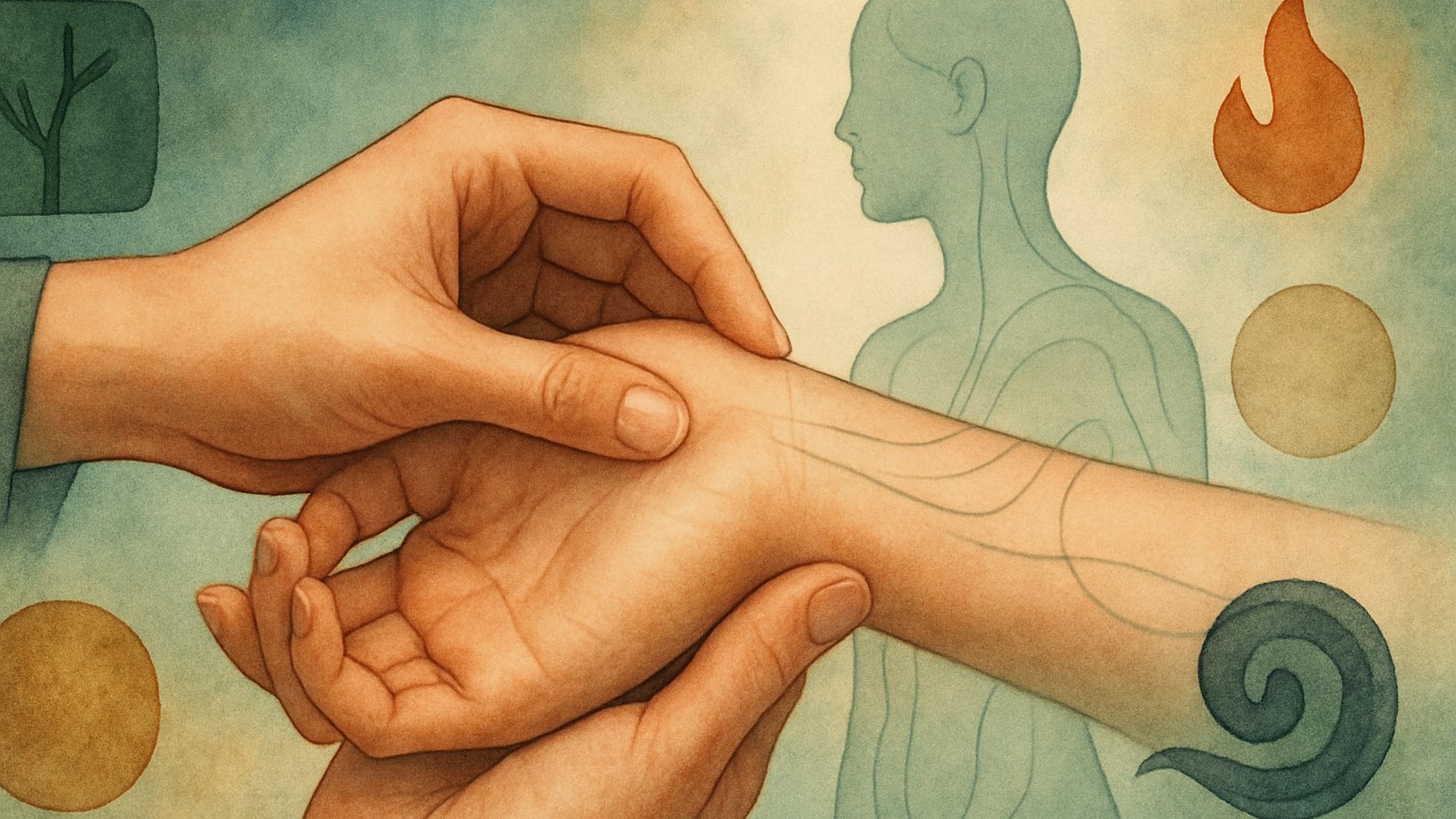
Pressing the inside of the wrist before a rough flight, rubbing the web between thumb and index finger during a headache, or massaging the hollow beneath the base of the skull when the neck is tight: these are small acts of care familiar across many cultures. In acupressure, they become a deliberate practice. The method uses firm, comfortable finger or thumb pressure on selected acupoints—the same mapped sites used in acupuncture, but without needles.
That distinction matters. Acupuncture usually involves a trained practitioner inserting fine needles; acupressure is manual stimulation, sometimes delivered by a clinician and sometimes used as a self-care technique. Neither should be treated as a substitute for diagnosis or urgent medical treatment. But for ordinary, short-lived discomforts such as tension, mild nausea, or stress-related tightness, gentle acupressure can be a practical ritual: it asks a person to pause, breathe, notice the body, and apply focused touch.
From early Chinese medicine to a modern self-care practice
Acupuncture and moxibustion developed within a broad and changing body of Chinese medical traditions—not a single unaltered system preserved unchanged for millennia. Moxibustion uses heat from burning mugwort; acupuncture uses needles; massage traditions such as tui na use hands. Early medical manuscripts found at Mawangdui, sealed in the second century BCE, describe eleven vessels or channels and moxibustion practices. Later classical literature, especially the Huangdi Neijing (Yellow Emperor’s Inner Classic), developed a more elaborate framework of channels, organs, points, diagnosis, and treatment. A scholarly history of moxibustion and early meridian theory emphasizes that the channel model developed over time from earlier concepts of vessels rather than appearing fully formed at once.
Modern “traditional Chinese medicine” (TCM) is therefore best understood as a living set of medical lineages, texts, clinical methods, state-standardized education, and contemporary adaptations. It is also not identical to biomedicine. Chinese medicine historically sought patterns of relationship—between sleep, appetite, emotions, climate, seasons, pain, digestion, and vitality—rather than locating every complaint in one discrete lesion or laboratory value.
What are meridians—and what are the Five Phases?
In Chinese medicine, meridians, also translated as channels, are routes through which qi is said to circulate and through which the body’s systems communicate. Points are specific places where a practitioner may influence that circulation. Classical theory describes twelve primary channels associated with organ systems, alongside additional extraordinary vessels and networks of connecting channels.
This is a traditional explanatory map, not a confirmed anatomical network equivalent to nerves, arteries, or lymphatic vessels. Researchers have investigated possible mechanisms for acupuncture and pressure stimulation—including local connective tissue, sensory nerves, pain modulation, expectation, and autonomic nervous-system effects—but no single modern anatomical structure has been established as “the meridian.” That limitation does not make people’s experiences of relief imaginary; it means the language of channels belongs to a different medical framework and should be described honestly as such.
The same care applies to the so-called Five Elements, more accurately translated as the Five Phases (wuxing): Wood, Fire, Earth, Metal, and Water. They are not chemical ingredients in the body. They are dynamic categories used to describe change, relationship, and balance. In classical correspondences, Wood is associated with growth and the Liver/Gallbladder systems; Fire with warmth and the Heart/Small Intestine; Earth with nourishment and the Spleen/Stomach; Metal with boundaries and the Lung/Large Intestine; Water with storage and the Kidney/Bladder. A Chinese-medicine clinician may use these relationships to interpret a pattern. They should not be mistaken for biomedical diagnoses of those organs.
What does the evidence say about acupressure?
Evidence is strongest, though still uneven, for acupressure as an adjunct for nausea and some forms of pain. The wrist point PC6 is particularly well studied for nausea and vomiting, including pregnancy-related nausea and postoperative nausea. A 2023 systematic review and meta-analysis of randomized trials examined acupressure for nausea and vomiting in pregnancy, while earlier reviews found promising results but also frequent risks of bias in the underlying studies. The 2023 review of acupressure for pregnancy nausea is useful precisely because it shows both why the method remains of interest and why broad claims need restraint.
For headaches, pain, insomnia, anxiety, digestion, immunity, hormonal “balance,” or chronic disease, claims are often much broader than the evidence. Acupressure may feel soothing, may help some people manage symptoms, and may work partly through attention, relaxation, touch, expectancy, and changes in behavior. Those pathways are meaningful. They do not establish that pressing a point cures disease or that a person’s thoughts caused their illness.
The safest approach is modest: use acupressure to support comfort, not to delay care. Seek medical help for chest pain, severe or sudden headache, weakness, fainting, breathing difficulty, signs of stroke, persistent vomiting, injury, fever with a stiff neck, or symptoms that are new, severe, or worsening.
How to use a point without turning it into a test
Find the general area, then explore gently. A point may feel tender, warm, or simply neutral; tenderness is not proof that you have found a problem. Use the pad of a thumb or finger, press until there is a clear but tolerable sensation, and make small circles or hold steady pressure for 30 to 90 seconds while breathing slowly. Repeat on the other side where relevant. Stop if pressure causes sharp pain, numbness, dizziness, bruising, or distress.
Point locations in professional acupuncture use proportional body measurements and careful anatomy, standardized in the WHO Standard Acupuncture Point Locations in the Western Pacific Region. The descriptions below are intentionally practical rather than a substitute for that clinical precision.
10 common acupressure points
- LI4 — Hégǔ (合谷), “Joining Valley” / Large Intestine 4.
Location: On the back of the hand, in the fleshy web between thumb and index finger; bring the thumb and index finger together and look for the highest point of the muscle mound.
Traditional use: Head discomfort, facial tension, neck and shoulder tightness, and a sense of constrained energy.
What to know: Memorial Sloan Kettering includes LI4 in patient guidance for pain and headaches. Its LI4 acupressure guide also advises avoiding this point during pregnancy unless a qualified clinician says otherwise. - PC6 — Nèiguān (内关), “Inner Pass” / Pericardium 6.
Location: On the inner wrist, about three finger-widths below the wrist crease, centered between the two prominent tendons.
Traditional use: Nausea, unsettled stomach, palpitations, anxiety, and chest oppression.
What to know: This is the point used by many nausea wristbands and is among the better-researched acupressure sites for nausea. - ST36 — Zúsānlǐ (足三里), “Leg Three Miles” / Stomach 36.
Location: About four finger-widths below the lower outer edge of the kneecap, roughly one finger-width to the outside of the shinbone.
Traditional use: Digestive discomfort, fatigue, resilience, and general support for vitality.
What to know: It is one of the most frequently used points in acupuncture traditions, but “boosting immunity” claims should not be treated as established clinical fact. - SP6 — Sānyīnjiāo (三阴交), “Three Yin Intersection” / Spleen 6.
Location: On the inner lower leg, about four finger-widths above the high point of the inner ankle bone, just behind the edge of the tibia.
Traditional use: Menstrual discomfort, sleep difficulty, pelvic tension, and digestive patterns.
Safety: Do not self-stimulate this point during pregnancy unless directed by a qualified maternity clinician or acupuncturist. - LV3 — Tàichōng (太冲), “Great Rushing” / Liver 3.
Location: On the top of the foot, in the depression between the big toe and second toe bones, moving back from the web space.
Traditional use: Stress-related tension, irritability, headaches, and menstrual discomfort.
What to know: This point is often paired with LI4 in practice; for self-care, use light pressure rather than trying to reproduce a treatment protocol. - GB20 — Fēngchí (风池), “Wind Pool” / Gallbladder 20.
Location: At the back of the neck, in the hollows below the skull on either side of the neck muscles.
Traditional use: Neck stiffness, tension-type headache patterns, and eye fatigue.
Safety: Press upward and inward gently; do not forcefully compress the front or side of the neck. - BL40 — Wěizhōng (委中), “Middle of the Crook” / Bladder 40.
Location: At the midpoint of the crease behind the knee.
Traditional use: Low-back tightness, hamstring tension, and stiffness along the back of the body.
Safety: Use only light touch in this sensitive area. Do not massage a swollen, hot, red, or painful calf or leg; seek prompt medical assessment instead. - CV17 — Shānzhōng (膻中), “Chest Center” / Conception Vessel 17.
Location: At the center of the breastbone, level with the nipples.
Traditional use: A feeling of chest tightness, grief, shallow breathing, or emotional congestion.
What to know: Gentle palm contact and slower exhalations may be more appropriate here than deep pressure. Chest pain or pressure requires medical evaluation, not acupressure. - GV20 — Bǎihuì (百会), “Hundred Meetings” / Governing Vessel 20.
Location: On the crown of the head, approximately where a line running up from the tops of both ears meets at the midline.
Traditional use: Mental agitation, head heaviness, concentration, and a sense of being ungrounded.
What to know: Use soft, still contact. A sudden severe headache, confusion, or neurological symptoms are not self-care territory. - Yìntáng (印堂), “Hall of Impression” / extra point.
Location: Midway between the inner ends of the eyebrows.
Traditional use: Restlessness, forehead tension, sleep preparation, and quieting the mind.
What to know: It is an extra point rather than one of the numbered primary-channel points. It pairs naturally with a minute of slow breathing before bed or during a stressful pause.
A map for attention, not a promise of control
The enduring appeal of acupressure may lie partly in its scale. It offers a way to respond to the body that is neither passive nor grandiose: a hand on the wrist, a pause at the neck, a few unhurried breaths. Within Chinese medicine, this is understood through qi, channels, and changing patterns of balance. Within contemporary psychology and physiology, it may also involve focused attention, soothing touch, reduced muscular guarding, expectation, and a brief interruption to stress.
Those explanations need not be forced into a false choice. Acupressure can be respected as a historically rich practice while its clinical claims remain proportionate to evidence. Use it as a companion to rest, hydration, movement, prescribed treatment, and professional care—not as a verdict on what your body needs or a guarantee that discomfort will disappear.
Sources and references
- WHO Standard Acupuncture Point Locations in the Western Pacific Region
- WHO Benchmarks for the Practice of Acupuncture
- Acupuncture: Effectiveness and Safety
- Efficacy and safety of acupressure in nausea and vomiting during pregnancy: a systematic review and meta-analysis of randomized controlled trials.
- Acupressure for Pain and Headaches
- Moxibustion in Early Chinese Medicine and Its Relation to the Origin of Meridians: A Study on the Unearthed Literatures
More to read
Your Watch Says You’re Stressed. What, Exactly, Does It Know?
A “high stress” alert can reflect poor sleep, a hard workout, alcohol, illness, a warm bedroom—or psychologic…

When Money Stops Sleeping: How Instant Payments Are Rewriting Corporate Cash Management
U.S. instant-payment networks are moving from novelty to serious commercial infrastructure. The bigger shift …
The Attack Surface in Your Chat Window: How Ordinary Users Can Think About AI Security
Generative AI changes what a chat window can see, remember and do. A guided workday shows where ordinary choi…
Apps to use

Video Converter
Convert videos between popular formats directly in your browser — privately, locally, and without uploading y…
Acupreference
An interactive acupuncture and acupressure reference for exploring points, channels, traditional uses, and pr…
Song Title Finder
Generate song titles, album names and artist or band names from a large library of 74,000+ title fragments.